Clarity Hits Different: Part 1 - Metabolism
How seeing your metabolism through a functional lens changes everything
You’ve tried to “be good.”
You’ve counted the carbs, swapped your creamer, added the greens, taken the walk, chosen the salad, skipped the wine… and still felt:
Your energy tanks out of nowhere
Your weight refuses to budge
You’re hungry and not hungry at the same time
You crash at 3 p.m. like clockwork
You wake up exhausted even when you sleep
Your brain feels foggy, irritable, or just… slow
Every new plan works for five minutes and then falls apart
And the kicker?
Your labs come back “normal.”
So you’re left wondering:
Is it me? Am I missing something? Why does my body feel so unpredictable?
Let me reassure you — your metabolism isn’t moody, lazy, or stubborn.
It’s communicating. And it’s been doing that all along.
You just haven’t been given the lens to understand it.
Why your metabolism feels like a moving target
Most women are told that metabolism is basically:
calories, carbs, weight, exercise… the end.
But your metabolism is far more complex — and far more sensitive — than that story suggests.
It shifts in response to:
Stress (both the life kind and the hidden physiological kind) (Tsigos & Chrousos, 2020)
Blood sugar swings (Roh et al., 2017)
Inflammation (Hotamisligil, 2017)
Nutrient depletion
Thyroid signaling
Sleep and circadian rhythms (Stenvers et al., 2019)
Gut imbalances (Cani & Jordan, 2018)
Hormone fluctuations
When one of these pieces moves, your metabolism adapts — sometimes gracefully, sometimes with a little attitude.
Traditional labs capture snapshots, not patterns, which means the deeper “why” is easy to miss.
This is where the functional lens changes everything.
What you’re feeling is chemistry talking
Every frustrating moment you’ve had with your metabolism ties back to a biochemical pattern.
That sudden crash? Your glucose dipped faster than your brain prefers (Lamport et al., 2020).
That wired-tired feeling at night? Cortisol is stepping on the gas while melatonin’s trying to land the plane.
That stubborn weight? Chronic inflammation and insulin resistance can block your cells from receiving metabolic signals (Bugianesi et al., 2019).
That endless hunger? Blood sugar instability + stress hormones create mixed messages.
That brain fog? Your neurons rely on steady fuel; glucose swings disrupt cognitive function (McNay & Cotero, 2019).
There’s always a reason.
Your symptoms aren’t personality flaws or lack of discipline — they’re data points.
How a functional lens changes everything
We don’t just look at the numbers — we lookbetweenthem
Your fasting glucose by itself doesn’t tell the story.
Neither does your A1c.
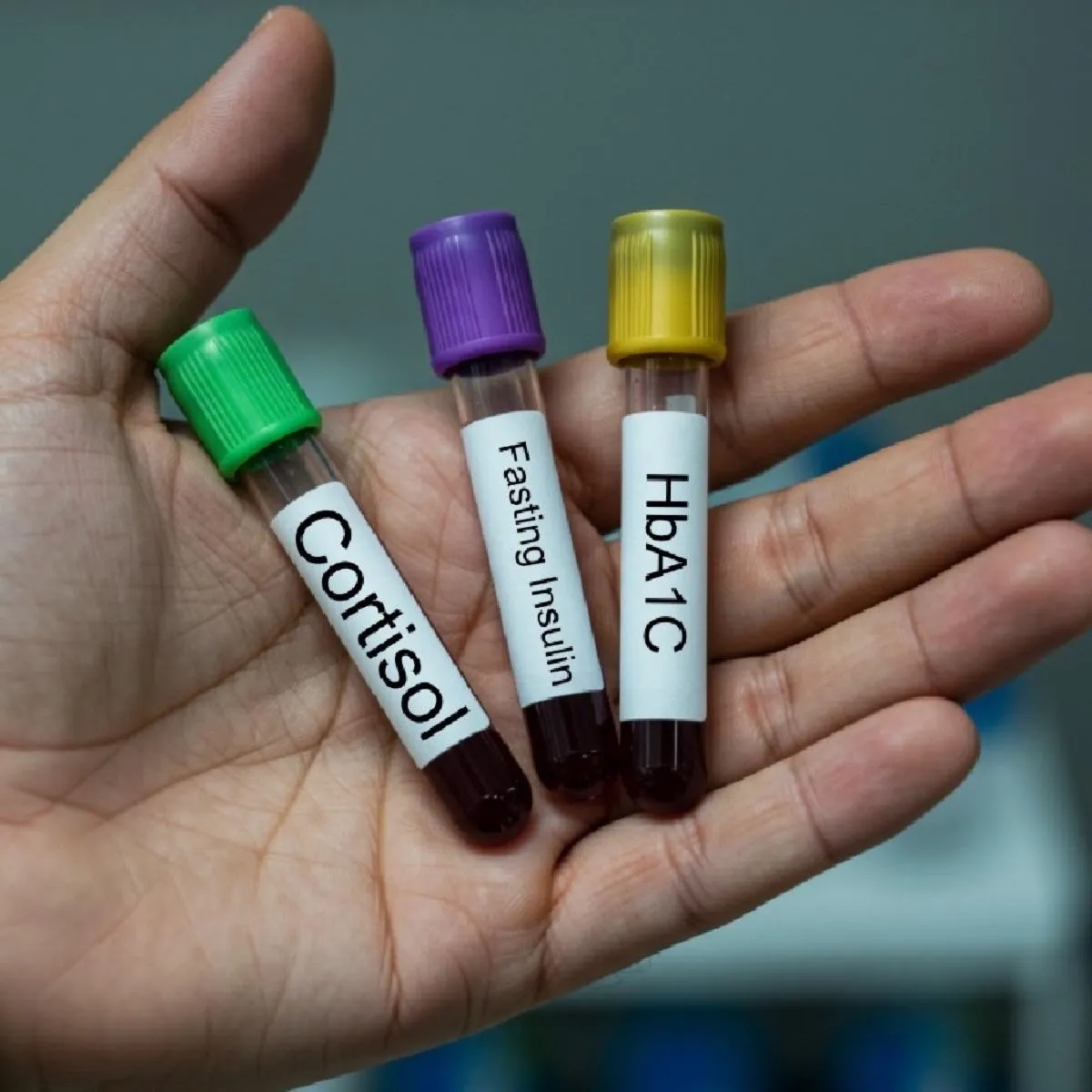
But when we layer insulin, lipids, CRP, micronutrients, and cortisol patterns together, the real picture comes into focus.
We compare you to optimal — not just “not sick”
Conventional ranges are designed to diagnose disease.
Functional ranges are designed to detect dysfunction earlier (Huber et al., 2021).
The difference matters — especially for women who “look normal on paper” but feel anything but.
We follow the story your numbers are telling
A single marker out of range isn’t always the issue.
But a constellation of almost out-of-range markers?
That’s where the real truth usually hides.
The patterns this lens helps us see
Hidden insulin resistance (even with “normal” glucose)
Inflammation patterns driving cravings, fatigue, and weight changes
Stress-driven glucose instability
Nutrient deficiencies slowing metabolic signaling
Thyroid pattern shifts contributing to sluggishness
Early mitochondrial strain from chronic metabolic stress
These patterns are incredibly common — they’ve simply been overlooked without the right lens.
What you can start paying attention to right now
You don’t need a full lab panel to start tuning into your body’s signals.
Begin noticing:
How steady (or unpredictable) your energy feels
Your hunger cues and cravings
Which meals give staying power versus a crash
Your sleep-wake rhythm
Mood changes around hunger or fatigue
What time your afternoon slump hits
How your body reacts after stress vs. after rest
These observations become powerful once they’re paired with your labs.
It’s like turning the lights on in a dim room — the shapes were always there; now you can finally see them.
If you're craving clarity…
You were never meant to guess your way through this.
Your metabolism has been whispering (and sometimes shouting) clues for years — but without a functional lens, it’s almost impossible to interpret them.
This is just the first step in a four-part series exploring how each system in your body tells its own story.
If you're ready to understand the full picture — thewhy, not just the what — you’ll want to be at the webinar.
Join the free class: The Lens That Changes Everything
I’m teaching a free class on how to understand your labs in a way that finally makes sense.
If your symptoms don’t match your “normal” labs…
If you’re doing everything “right” but still don’t feel right…
If you want clarity — not another quick fix —
This is for you.
👉Register for The Lens That Changes Everything Webinar, details coming soon!
👉Download this week’s free guide Your Numbers, Your Story
👉Follow along for Part 2 of the Clarity Hits Different Series — Gut & Digestion
Clarity really does hit different — and this is where it begins. 💜
📚References
Bugianesi, E., Rosso, C., & Cortez-Pinto, H. (2019). How to diagnose metabolic dysfunction-associated fatty liver disease (MAFLD).Journal of Hepatology, 71(6), 1236–1241.
Cani, P. D., & Jordan, B. F. (2018). Gut microbiota–mediated inflammation in obesity: A metabolic dialogue in the context of personalized nutrition.Current Opinion in Clinical Nutrition and Metabolic Care, 21(6), 417–422.
Hotamisligil, G. S. (2017). Inflammation, metaflammation and immunometabolic disorders.Nature, 542, 177–185.
Huber, P., Rogozina, A., & Costello, A. (2021). Redefining laboratory reference intervals: Why “normal” isn’t always optimal.Integrative Medicine Research, 10(3), 100–112.
Lamport, D. J., Lawton, C. L., Mansfield, M. W., & Dye, L. (2020). Impaired glucose tolerance and cognitive function: A systematic review.Neuroscience & Biobehavioral Reviews, 118, 214–225.
McNay, E. C., & Cotero, V. (2019). Mini-review: Impact of recurrent hypoglycemia on cognitive and brain function.Physiology & Behavior, 199, 11–16.
Roh, E., Kim, M. S., & Kim, Y. A. (2017). Brain regulation of glucose metabolism.Experimental & Molecular Medicine, 49(12), e415.
Stenvers, D. J., Scheer, F. A., Schrauwen, P., la Fleur, S. E., & Kalsbeek, A. (2019). Circadian clocks and insulin resistance.Nature Reviews Endocrinology, 15(2), 75–89.
Tsigos, C., & Chrousos, G. P. (2020). Stress and the HPA axis: Clinical implications.Endocrinology and Metabolism Clinics, 49(3), 401–417.
